Table of Content
The Dealing Game – A contestant must choose from two unknowns. Before choosing, Wayne and Jonathan reveal information about their respective unknowns by answering Dating Game style questions. Seven Envelopes – Choosing four of seven envelopes, each containing $1 and $2 bills, whose contents they hoped added up to at least $7 for a grand prize. At various points, the host would stop and offer a buy-out.
In 2010, Pressman Toy Corporation released an updated version of the box game, with gameplay more similar to the 1974 version, featuring Brady on the box cover. In the simplest format, a trader is given a prize or cash amount of medium value , and the host offers them the opportunity to trade for an unknown prize. This latter item may be concealed on the stage behind one of three curtains, within a large "box" onstage , inside a smaller box carried on a tray, or occasionally in other formats.
Episode status
At certain stages of these games, Hall often offered a sure-thing deal to quit before the result was revealed. If all of Hall's offers were turned down and the grand prize lost, Hall would usually give the grocery items to the contestant as a consolation prize along with $50 or $100 in cash. Spell Me A Car – Two contestants face off each other in spelling out a six letter car name (or "WINNER" if the car letter name is less or more than six letters). To begin the game, Wayne will give each the contestant an envelope, one with $100, one with $50. The contestant that found the $100 goes first, the other will go second.

At that point, they can decide whether to go for the cash, or take a sure thing. Spell Me a Deal – The name of a mystery prize is hidden behind a "video chalkboard" (i.e. TV monitor). One at a time, a letter in the name of the prize is revealed.
Be A Part of LET’S MAKE A DEAL: AT HOME with Wayne Brady during NATPE Virtual Streaming Plus
After the first roll, he/she/they win a certain amount of cash. He/she/they can stop and take that money or continue rolling to collect more cash but if they roll the number previously rolled they lose everything and the game ends. The contestant can quit after each roll and will lose everything accumulated if they duplicate a roll at any point. If the contestant rolls all six numbers from 1 to 6 without duplication, they win a grand prize (either $20,000 or a car). Fridays are Fabulous Car Fridays, where one Trading game was played for a car worth over $30,000. These have included BMWs, Porsches, Mercedes-Benzes and--one one occasion--a Lamborghini worth over $347,000.
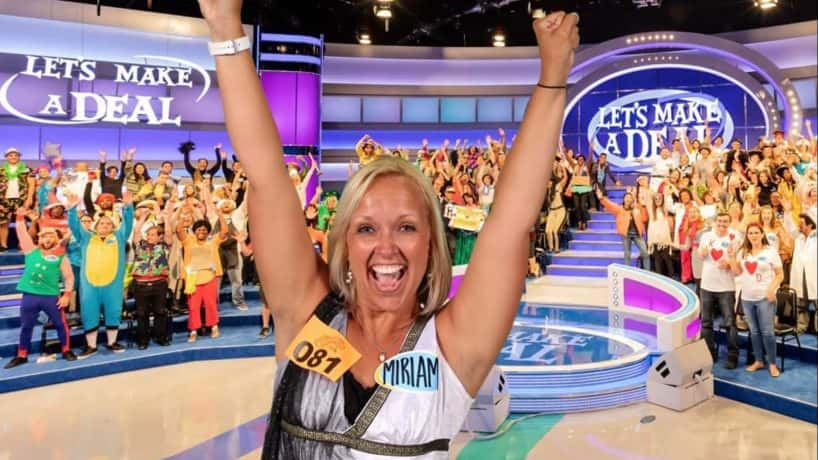
Please don’t include any music, logos or brands, or anything offensive, indecent or in bad taste in the picture/video. This is one of the first syndicated game shows to premiere once the Financial Interest and Syndication (fin-syn) rules were enacted in 1970. It was distributed by ABC Films and then by it's successor Worldvision Enterprises starting in 1973. Let's Make a Deal - A channel on Pluto TV that's devoted to the current Wayne Brade version 24/7. Music cues from other Hatos-Hall game shows that were recycled into Let's Make A Deal '76, '80, and '84 include Split Second, 3 for the Money, It Pays to Be Ignorant, It's Anybody's Guess, and Masquerade Party.
"Mega Money Mondays" & "Fabulous Car Fridays"
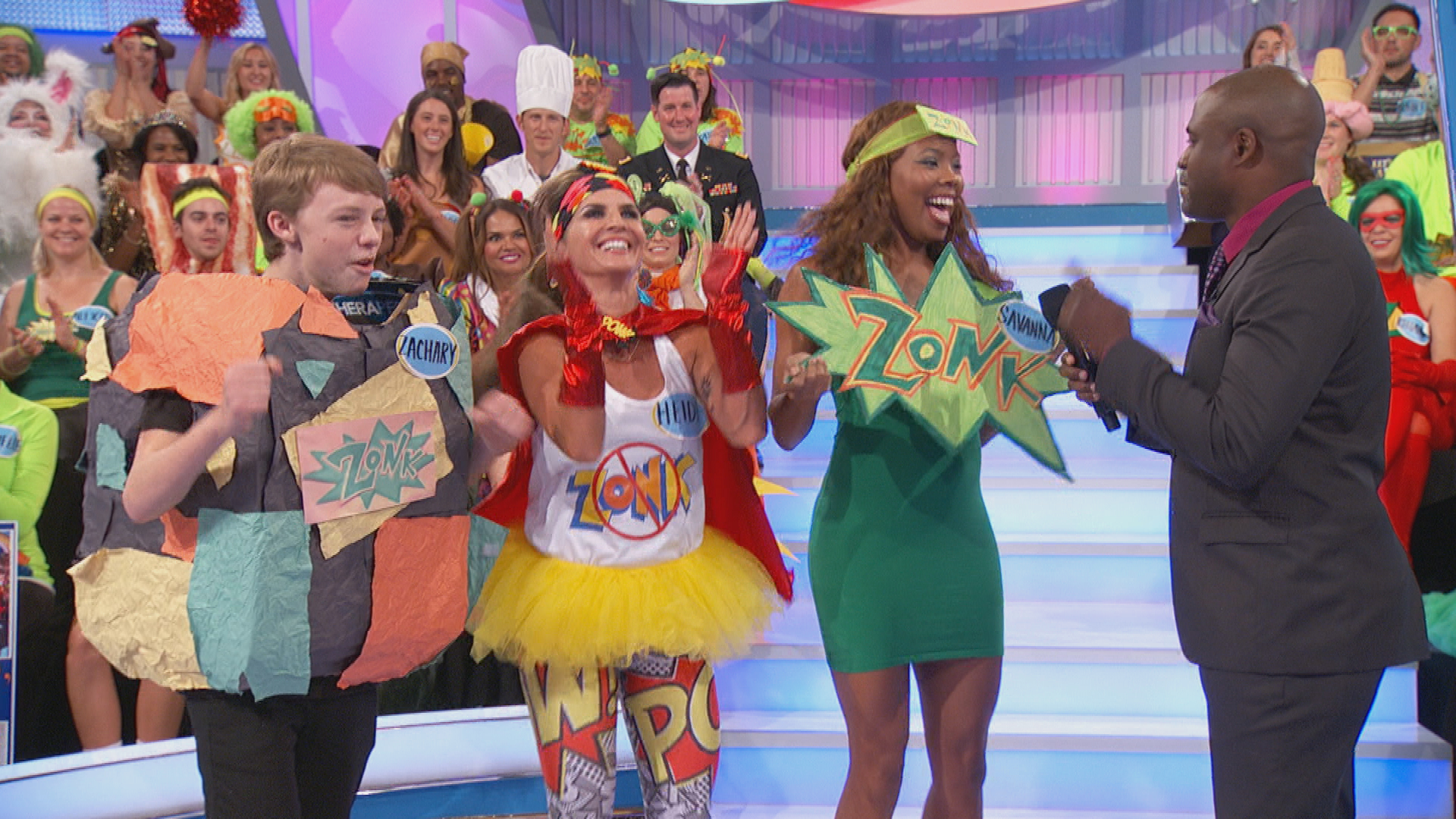
After the fourth roll, Wayne offers the contestant another unknown which also provides the contestant an opportunity to take whatever money won. If the contestant goes over $1,000, the contestant wins nothing. Accelerator – A contestant can win a car in this roulette-style game. The player rolls a giant ball down a ramp which lands on a spinning roulette-style wheel with the letters C, A, and R, each appearing four times and concealing a cash amount. Each time a letter is collected, the cash amount behind is revealed and awarded to the player; but once that letter is collected, all instances of that letter are converted to zonks. If a player hits a zonk, all money accumulated is lost; but if all three letters are collected, the car is won along with all cash accumulated.
The first trader to collect a pre-announced amount (usually $700) won a grand prize, such as a car or a trip . The losing trader/couple was offered a regular take-it-or-leave-it deal in exchange for any cash accumulated. The consolation deal was also played for both teams if both obtained less than the required amount. The following games were played for a grand prize, such as a car or trip, and almost always involved grocery items.
Third Game: Big Deal of the Day
So if they have lost at everything else , then this is their chance to at least get something. I had a ton of leftover diaper boxes I was needing to get rid of so we used those to recreate a version of the game “Smash for Cash.” I hid Monopoly money under 4 of the 6 diaper boxes which added together would total $10. They hoot and holler every time someone wins a car and groan when someone loses. The problem has been analyzed many times, in books, articles and online. S debut, journalist Charles Witbeck was skeptical of the show's chances of success, noting that the previous four NBC programs to compete with CBS's Password had failed. Some critics described the show as "mindless" and "demeaning to traders and audiences alike".
One door hid the day's Big Deal, which was usually more than the top prize offered to that point. It often included the day's most expensive prize (a luxury or sports car, a trip, furniture/appliances, a fur, cash, or a combination of two or more of said items). The other two doors concealed prizes or prize packages of lesser value. Zonks were never included in the Big Deal, although there was always the possibility that a contestant could wind up with less than his or her original winnings. All three doors were normally opened, going in order of increasing value. In the CBS version, the other two doors are referred to as the "Small Deal" (worth $1,000+) and the "Medium Deal" ($3,000+).
The 2009 main was also used during Game Show Mashup week in 2016. The losing horns were also used if a contestant lost a game. Zonk Redemption – Usually held near the end of each season, contestants who got zonked got a chance to try again. The Vietnamese version called O cua bi mat ran three years on VTV3 from 2009 until 2012, hosted by Tran Ngoc. The short-lived British version called Trick or Treat hosted by Mike Smith and Julian Clary ran only for three months on ITV in 1989. A Portuguese version called Negocio Fechado ran for a brief period from 1999 until 2000 on SIC.
Each Let's Make a Deal announcer also served as a de facto assistant host, as many times the announcer would be called upon to carry props across the trading floor. The original announcer for the series was Wendell Niles, who was replaced by Jay Stewart in 1964. Stewart remained with Let's Make a Deal until the end of the syndicated series in 1977. The 1980 Canadian-produced syndicated series was announced by Chuck Chandler.




No comments:
Post a Comment